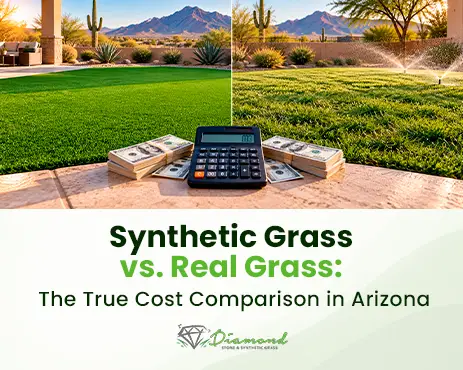
Natural grass has a lower upfront cost but a much higher cost over time in Arizona — typically $2,000–$4,000+ over 10 years in water, mowing, reseeding, and repair for an average lawn, compared to synthetic turf’s higher upfront cost ($8,000–$18,000 installed) but near-zero ongoing costs. Most Arizona homeowners reach breakeven on synthetic turf somewhere between year 5 and year 8, depending on lawn size and local water rates.
Arizona is one of the clearest cases in the country for running this comparison seriously, because natural grass is fighting the climate here in a way it isn’t in milder regions — which means the ongoing cost gap between the two options is unusually large.
Upfront Cost Comparison
| Natural Grass | Synthetic Turf | |
| Installation (avg. 1,000 sq ft yard) | $1,500 – $3,500 (sod + soil prep) | $9,000 – $15,000 |
| Irrigation system (if not existing) | $1,500 – $3,500 | Not required for turf areas |
Natural grass clearly wins on upfront cost — this is usually the first (and sometimes only) number homeowners compare, which is part of why the long-term picture gets overlooked.
Ongoing Annual Cost Comparison
| Cost Category | Natural Grass (Annual) | Synthetic Turf (Annual) |
| Water | $300 – $800+ | $0 |
| Mowing/maintenance service | $600 – $1,200 | $0 – $100 (occasional rinse/brush) |
| Fertilizer & weed control | $150 – $400 | $0 |
| Overseeding (winter rye, common in AZ) | $200 – $500 | $0 |
| Repair/reseeding dead patches | $100 – $400 | Rare |
| Estimated annual total | $1,350 – $3,300 | $0 – $100 |
Over a 10-year period, that gap compounds to $13,500–$33,000 in ongoing natural grass costs versus roughly $0–$1,000 for synthetic turf in the same window — before even accounting for turf’s 15–20 year lifespan meaning many homeowners won’t face a second material cost at all in that period.
When Natural Grass Still Makes Sense
- Very short-term ownership — if you’re planning to sell within a year or two, the upfront cost difference may not be worth it for you personally (though turf is increasingly viewed as a value-add by buyers).
- Large acreage where the upfront cost of full synthetic conversion is prohibitive, and partial natural grass is more budget-realistic.
- Personal preference for the feel and smell of natural grass, which is a legitimate factor some homeowners weigh regardless of the cost math.
When Synthetic Turf Makes the Most Sense
- You’re staying in the home 3+ years — this is roughly when the cost math consistently favors turf.
- You’re tired of the maintenance cycle — mowing, overseeding, fertilizing, and dealing with summer die-back are ongoing time costs, not just money.
- You have pets — synthetic turf with proper drainage handles pet use better than natural grass, which struggles to recover from heavy pet traffic in Arizona’s climate.
- Water conservation matters to you — either for environmental reasons or because local water rates and restrictions are trending upward.
The Non-Financial Factors Worth Weighing
Cost isn’t the only consideration. Natural grass supports a slightly cooler microclimate immediately around it and some homeowners simply prefer the look and feel. Synthetic turf, meanwhile, stays consistently green year-round (no winter dormancy or summer burn-out) and eliminates the mowing/maintenance time commitment entirely — which for many households is worth as much as the dollar savings.
Frequently Asked Questions
How long does it take for synthetic turf to pay for itself in Arizona? Most homeowners reach breakeven between year 5 and year 8, depending on lawn size, local water rates, and how much they were previously spending on lawn maintenance.
Does natural grass really cost that much more per year in Arizona? Yes, relative to synthetic turf — water, mowing, fertilizer, and the winter overseeding common in Arizona (to keep grass green through cooler months) add up to real annual costs that turf simply doesn’t have.
Is synthetic turf worth it if I’m planning to move in a few years? It depends on your specific timeline and local resale expectations, but quality turf is increasingly viewed as a value-add by Arizona buyers rather than a downside, given how well-understood the water savings are in this market.
Does synthetic turf save water even accounting for occasional rinsing? Yes — occasional rinsing for dust or pet odor uses a small fraction of what a natural lawn requires for regular irrigation, especially during Arizona summers when natural grass needs the most water.
Is there a cost difference between synthetic turf grades? Yes — turf grade, pile height, and infill type (standard sand vs. cooling infill) all affect price. Higher-grade options cost more upfront but often look and perform better for longer.
Curious What Synthetic Turf Would Cost for Your Yard?
Diamond Stone & Synthetic Grass installs premium artificial turf across Phoenix, Scottsdale, Glendale, Peoria, Mesa, Chandler, Gilbert, Tempe, and the surrounding Valley. Licensed, bonded, and insured (ROC #311158).
👉 See our synthetic grass services 👉 Get a free turf cost esti